Tag Archives: bar exam

Motivation Techniques for Studying for the Bar Exam

Although the time that you spend studying for the bar exam is not that long when compared to many other things you have done as a law student, it is an intensive, stressful, and often monotonous process. In the first days and weeks of bar prep, it can be relatively easy to stay focused on what you need to accomplish, but, as time goes on, it may be harder and harder to motivate yourself to spend the amount of time studying that is really required for success on the bar exam. At this point in the summer, it may be time to add some motivational techniques to your study plan.

Reward System

One way to motivate yourself as you study is to create a reward system. For example, some law students have already developed a reward system that is easily adapted to studying for the bar. In this system, the student chooses some type of snack system—it could be M&Ms, gummy bears, pistachios, blueberries, or something else that is small and appealing to you. One item is placed next to each paragraph, page, section, etc. of the study materials, depending upon how often you want to reward yourself. As you finish that part of your reading, you then get to eat your snack reward.

Another way to approach the reward system is to think of something that you really enjoy doing. Some examples might include: going to a movie; playing a video game; getting a pedicure; or going to the zoo or a museum. Set a “price” for that experience, in the form of points. Then determine how many points you can earn for various study activities. Study away and start racking up the points! Once you have earned enough points, you can “cash” them in for a little study break.

Giving yourself something to look forward to, however small, can be a great way of infusing new purpose into your studies.

Improved Study Environment

Another way to motivate yourself is to figure out a way to improve your study environment. Once again, this is a technique that gives you something to look forward to as you study. Maybe you love coffee—you might get yourself a gourmet bean that you only allow yourself to brew when you are studying for the bar exam. If tea is your thing, you might splurge on a special loose leaf tea and even make the brewing process part of your de-stress routine. It might be a special snack, or a lunch item that you look forward to. Or maybe it is a particular pen that is more expensive, but the smooth flow of the ink, or maybe its color, satisfies something inside of you. (Some people adopt inexpensive fountain pens, for example.)

Whatever it is, knowing that you have something special that you like but only get when you are studying can provide additional motivation for bar studies.

Accountability System

Finally, as we’ve discussed previously, creating accountability can be a great way of motivating yourself as you study for the bar. Approach a friend who is also in the midst of bar prep, and create a system with that person so that you check in each day and see how things are going. It’s amazing how, when you set goals and articulate them to someone else, you are inspired to accomplish what you’ve set out to do.

Whatever approach you decide to take, focus on motivating yourself to work hard at your bar studies. I’ve never heard bar takers say that they regretted studying hard for the bar, but I have heard those who failed the bar exam say that they wished they’d pushed harder.

Leave a comment

Filed under Bar Exam, General, Stress and Mental Health, Study Tips

Diagramming the Bar Exam: Using Visual Prompts to Strengthen Memory

Image courtesy of Stuart Miles/FreeDigitalPhotos.net

Image courtesy of Stuart Miles/FreeDigitalPhotos.net

Studying for the bar exam is not a one-size-fits-all strategy. It’s important to not to take a passive approach to your studies. Although commercial bar prep materials are helpful when you are studying for the bar, you should go beyond the pre-packaged outlines and videos. Don’t forget what you have discovered about your learning preferences as a student in law school. Using different approaches to attack your study materials can have a significant effect on what you remember for the exam.

I have already discussed one way that you can change up your bar studies approach: flashcards. Today, I want to talk about another technique that can help you remember more of what you study: the creation of diagrams, flow charts, and other visual materials. If you are a visual learner, diagrams and flow charts can help you to remember the steps required for legal analysis of complex legal issues or how various sub-issues are related to each other. The process of creating the diagram or flow chart helps you to synthesize important legal principles, and, having studied the diagram or flow chart, you should be able to recall it more easily in the midst of the exam.

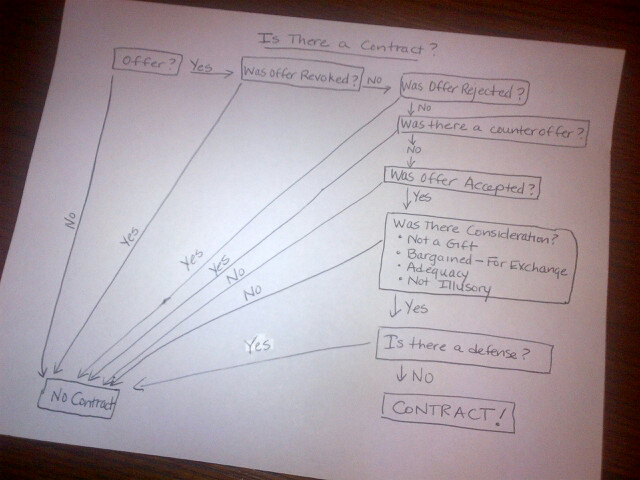
Here’s a simple example of how such a diagram or flow cart could be constructed. Let’s say you are reviewing Contracts, and you want to make sure that you remember the key steps for determining whether an enforceable contract has been created. Here’s what a simple version of that diagram might look like:contracts flow chart

Keep in mind, this would only be the starting point. As you continued to study, you might decide you want to incorporate more concepts into the flow chart, such as: (1) Mistake; (2) whether terms were definite; (3) whether promissory estoppel should apply; etc. You may make several versions of the flow chart before you have incorporated everything you want into it. The process of thinking through where all of the legal principles should fit will help you to remember them better, and in the end you will have a study aid that you can reference over the next several weeks as you study for the bar.

The key is to not get stuck studying your bar materials in a passive way—figure out a way to make it yours, and you will know it even better!

Leave a comment

Filed under Bar Exam, General, Study Tips

Flashcards and Bar Prep

By now, those of you who are studying for the July bar exam should be settling into a regular study routine. As you discovered during your time in law school, there are some legal concepts that you just have to memorize to be successful on an exam, whether it is the final exam in Torts or the bar exam. As a result, you may want to pull an old tool out of the study toolbox—flashcards. Flashcards can help you memorize important rules, tests, and definitions that you will need to recall during the bar exam. They can be especially helpful as you juggle learning and reviewing material from numerous bar subjects. Flashcards can also help you assess what you know versus what concepts you need to spend more time on, allowing you to make efficient use of limited time.

There are two possible approaches to flashcards: (1) the old school, index card type of flashcard that is either handwritten or typed (the “traditional” flashcard); or (2) digital flashcards that can be viewed on a computer, smartphone, iPad, or other digital reader. Each type has its benefits and drawbacks, as discussed below. You just have to decide which type will work best for you.

Traditional Flashcards:

Image courtesy of Stuart Miles/FreeDigitalPhotos.net

Image courtesy of Stuart Miles/FreeDigitalPhotos.net

First, let’s talk about the traditional flashcard. For those of you who do not like to study from a digital screen or aren’t as comfortable using technology, the traditional flashcard may be your default approach. One of the benefits of the traditional flashcard is that many students find that the process of writing out each card actually helps them to remember concepts better, even before they actually start studying from the cards. For people who like a visual reference of what has been accomplished and what is left to learn, stacks of flashcards satisfy that need. It is possible to carry around a small number of traditional flashcards regardless of where you go, and you don’t have to worry about low batteries, loss of internet connectivity, etc.

On the flip side, making handwritten flashcards can be a tedious process, especially when you are creating them for every bar subject. They are easily lost or ruined (such as when your elbow catches that cup of coffee and knocks it over). And if you are one of those people who tries to reduce the entire BarBri outline to a comprehensive series of flashcards, you may take so much time on one subject that nothing else gets done before it’s time to take the bar.

Digital Flashcards:

So what about digital flashcards? Digital flashcards also have their benefits and drawbacks. One of the benefits of digital flashcards is their portability. If you have a smartphone with a flashcard app, you literally can carry your flashcards with you everywhere you go. As I’ve talked about before, there are any number of basic flashcard apps available on the internet for free or at a low cost, such as Flashcard Machine and Quizlet. You may have already discovered a program that works really well for you. Depending on the program, there may be limitations though. It may be difficult to separate out cards that you want to concentrate on for a single study session, or the ability to temporarily combine particular subjects together in a random way (how it will be on the MBE) may be limited. Not all apps work on all devices either. Some only work on Apple devices, while others work with android platforms. Very few seem to work with Blackberries, if you happen to have one of those.

Another benefit—and drawback—to many digital flashcard programs is that they allow you to share your flashcards with others. On the plus side, this means that you and two of your best friends could divide and conquer the flashcard creation process . . . if you trust those people’s judgment calls about what is flashcard-worthy. On the negative side, most people end up knowing best the cards that they created themselves.

A New Type of Digital Flashcard for Law Students and Bar Takers: SeRiouS:

There is also a new digital flashcard program specifically for law students and bar takers called SeRiouS.

Here’s a video explaining how SeRiouS works:

From my exploration of the SeRiouS platform, there are two different ways that you can use it. First, you can utilize flashcards, created by law professors, on a variety of bar subjects. As it stands right now, there are over 600 different flashcards on mostly MBE topics, but it appears that more will be added over time. Second, you and your friends can create your own cards as well. The benefit to SeRiouS is that it draws upon scientific research regarding memory. As you go through each flashcard, you rate how confident you felt about your answer. Based upon your level of confidence, SeRiouS applies an algorithm to determine how often you see that flashcard as you study—a process called spaced repetition. The principle is that, as you start studying a topic, you need to review it frequently in order for it to be stored in your memory. As you continue to review that same topic over time, however, you need to see it less and less often to maintain it in your long-term memory. (I’m not an expert on the subject, but this is how I understand it.) One of the drawbacks to this program is that the website is a little hard to navigate at first until you figure out where everything is located, but it shows a lot of promise. A plus is your ability to chart your mastery of the cards (it gives you an update about your status) as well as gentle reminder emails to get back to reviewing your flashcard deck. At this point, SeRiouS is in the beta stage and available without cost to law students and bar takers at least through the July bar exam period.

**This blog post is not an endorsement of any product mentioned herein; I am just providing some suggestions of resources that are available for you to explore.

Leave a comment

Filed under Bar Exam, General, Study Tips, Technology

Accountability Creates Motivation: Studying for the Bar Exam, Part 3

It’s now only two months before the July Bar Exam, and everyone should be busy studying at this point. At times, it can be hard to find the motivation to study, especially when the exam date still feels like it’s far away. Your commercial bar prep program may seem a little monotonous, as you seem to do the same thing every day: watch a lecture (whether in person or online), study the outlines and supplemental materials, complete the practice questions, repeat. It can be tempting to watch TV, play computer games, or do something else when you should really be studying. Keeping yourself motivated at this time is key, and one way to motivate yourself is to establish some type of accountability system.

What do I mean by accountability? Sometimes it is easier to not focus on what we need to be doing when we feel that no one will know about our lack of progress on our studies. If your bar review course gives you the option of attending lectures in person or watching them online, attending them in person may help you to be more accountable for your studies—the people around you will notice if you are missing. It can also help to set up some type of accountability system with a friend who’s also studying for the bar exam. It may be that you just touch base with each other every couple of days to make sure you are each on track with your study goals, or you may actually schedule study sessions where you quiz each other on material that you have just finished reviewing. Another way to create accountability would be to reach out to someone in charge of Academic Success or Bar Skills programs at your law school. Explain what your study goals are and that you want to create some type of accountability system to keep you on track.

When you know that someone cares about your achieving your study goals and will know if you don’t achieve them, you will be more motivated to stay on focused on your studies. Accountability creates motivation!

Leave a comment

Filed under Bar Exam, General, Study Tips

Countdown to the Bar Exam, Step 2: Creating the Right Study Environment

Photo courtesy of Apolonia/freedigitalphotos.net

Photo courtesy of Apolonia/freedigitalphotos.net

One important element of studying for the bar exam is creating the right study environment. You can have the best intentions, but the wrong environment can derail your entire study plan. One key to effective studying is a location that allows you to study efficiently and without distractions.

Here are some things to think about as you decide where to study for the bar:

What were the things that distracted you from studying when you were in law school? If you are constantly tempted to turn on the TV, then studying in your living room may not be for you. If studying in the law school library meant that you visited with friends rather than getting work done, then the same might hold true as you study for the bar. Some people prefer the background noise of a coffee shop, while others find themselves listening in to every conversation at the tables beside them. Be realistic in your assessment of what distracts you, and choose a study environment that avoids those distractions.

What do you like to do when you take breaks from studying? If you want to be able to take a short walk, then setting up your study station at the local coffee shop may not make sense—you won’t want to have to pack up your stuff every time you take a break. On the other hand, if your idea of a great break is checking your email and spending 20 minutes playing computer games, then a more public location may not be an issue. Just make sure that your study location is conducive to taking study breaks.

What space do you need to study? Some people prefer to study at a desk or table, where they can spread out their materials and have plenty of space to work. Others prefer to sit on a comfortable couch, overstuffed chair, or even the floor. Think about what type of space makes you feel most comfortable when you are studying—you’re going to spend a lot of time there.

Do you want to be able to eat or drink while studying? This is an important consideration, as many people like to have snacks and drinks available as they study. If you want endless amounts of coffee or periodic snacks of pretzels, fruit, etc., a library with a strict food and drink policy may not be the place for you. Likewise, if you are on a tight budget this summer, an expensive coffee shop may not work as well. Choose a study location that fits with your snacking habits.

Finally, do you like the routine of studying in the same space all the time, or will you need to change things up periodically? For some people, maintaining the same routine every day—studying at the same place at the same time—works best. For others, a little variety in the order and location of the routine helps them to stay focused. Depending on your own preferences, you may find that you want to change up your study location sometimes. Periodically reassess your study environment and make sure it still works best for you.

The perfect study environment is a very personal thing—experiment and find out what works best for you!

Leave a comment

Filed under Bar Exam, General, Study Tips

Countdown to the Bar, Step 1: Introduction to Studying for the Bar Exam

Image courtesy of digitalart/FreeDigitalPhotos.net

Image courtesy of digitalart/FreeDigitalPhotos.net

Congratulations to all of those 3Ls out there who have just graduated or are about to graduate! You have made it through law school! It’s a great accomplishment, and you should definitely celebrate with friends and family. It doesn’t take long though for the realization to dawn that the bar exam is looming in the distance. That’s why it’s a good opportunity to talk about how to approach studying for the bar exam.

In reality, you have learned most of skills you need for bar exam success during your years in law school. Although studying for the bar exam is a pretty intensive experience, if you continue to apply the types of techniques that contributed to your success in law school, you should be on your way to success on the bar exam as well. With that in mind, here are some suggestions as you begin the countdown to the bar exam:

First, if you have not done so already, sign up for a commercial bar review course, such as BarBri, Kaplan, or one of other state-specific bar prep courses. Most law students take a bar review course, and it’s been my experience that students who do not take one tend to not pass the bar exam. Although these courses cost a significant amount of money, that money is a good investment in your future. It is much more costly not to pass the bar and therefore not be able to practice law. You should research your options and determine which bar review program works best for you. It should be specific to the state where you are scheduled to take the bar exam, and you should consider your personal learning preferences, need for structure and discipline, etc. in deciding whether to take a course in person or over the internet. Most of these courses begin in the next week or two, so if you have not chosen a course you should do so quickly.

Second, treat studying for the bar exam like a job. Regardless of whether you take your bar review course in a classroom, view videos online, or study solely from workbooks and other printed materials, you should schedule your study time each day. Set a specific schedule for yourself, just as you would during the school year during law school. Get up at the same time each day, set specific times to go over new material or review material already covered, and set aside specific times that you will take practice exams or go over practice questions.

Third, don’t forget to take good care of yourself during the next few months as you study. It’s important that you eat well and get a good sleep every night so that your brain functions at its best and you don’t wear down your immune system. Take regular breaks from your studies, and don’t forget to get some exercise. Studying for the bar exam is not a sprint, but a marathon—you have to take care of yourself for that journey.

Stay tuned to this blog over the next few weeks, as I continue to give you tips about studying for the bar exam—let the countdown begin!

Leave a comment

Filed under Bar Exam, General

Sleep for Success: Stealing Time from Sleep Doesn’t Help You Do Better

The other day I had a student tell me that he planned to stay up all night studying for his next final exam. His statement brought back memories of my own years in law school, studying in a coffee shop early in the morning before the Civ. Pro. final as some of my fellow law students–those who had stayed up all night studying–either crashed with their heads on the tables or drank gallons of coffee in a desperate attempt to make their brains function. One of my friends once told me that, during one of her finals, a student fell asleep in the middle of the exam. Other students sitting around him surreptitiously tried to wake him up without causing a disruption to the rest of the class.  My friend looked over again about 20 minutes later, and he was once again asleep.

At the time, staying up very late–or even all night–may seem to make sense as you are studying for your final exams. The final exam period is a very stressful time, and there never seems to be enough hours in the day for studying. Law students may have four or five finals during a 10 to 14 day period, and often the entire grade for each course hangs in the balance. If you didn’t get your outlines done before the semester ended, you may still be scrambling to synthesize course information and memorize key concepts. If you don’t sleep less, then how will you get enough time to study before finals?

The problem with this reasoning is that sleeping less does not necessarily mean a better outcome on the exam. You’ll be more tired, have a harder time focusing on what you are doing (either studying or actually taking the exam), or even fall asleep at critical moments, like the law student in my friend’s class. Just because you study longer doesn’t mean you’ll do better. Studies have shown that sleep-deprived students don’t perform as well as those who get enough sleep, and they’re more susceptible to getting sick. It’s also important to remember that you are not just trying to learn this information for a short period of time–you are studying legal concepts that you will be tested on again during the bar exam.

So what should you do instead? Ideally you should study for your exams throughout the semester by outlining and creating flashcards. If you spread out your studying throughout the semester, you will not feel as much pressure during the exams period. It will be easier to balance studying with sleeping and taking good care of yourself by eating healthy and exercising.

At this stage though, you are already in the midst of exams. Lectures about the perils of procrastination aren’t going to help you with your immediate problems. Instead, you should take stock of where you’re at with each of your classes and how much time you have left before the final exams. Triage your studying. What are the most important things that need to be accomplished for each class? For example, it won’t be possible to create an entire outline for a course in 48 hours. A more productive approach at that point may be to start by creating the one-page checklist of topics I have described before, but this time drawing from your class notes and casebook table of contents. The checklist is a master list of the topics that could be tested on the exam. Once you have the checklist, you can evaluate which topics you feel pretty comfortable with versus those that you realize need more work. By consciously evaluating each course, you will be able to spend your time on those topics you’ve identified as needing more work, rather than on reviewing information you already know. Triage studying may not be a perfect solution (less procrastination would be better), but it is a better option than stealing time from sleep.

Leave a comment

Filed under General, Grades, Law School Exams, Study Tips

Perfecting the Law School Outline

It may sound crazy to talk about how to outline when we are already three quarters of the way through the school year, but outlining is a skill that you can constantly improve—whether you are a 1L, 2L, or 3L. I thought I would take this opportunity to discuss “best practices” for outlining. Maybe after reading this post, you will discover something that strengthens your outlining skills and make your outline do more work for you.

Of course, we use the word “outline,” but a law school outline can be so much more than a document organized by Roman numerals. While it is certainly possible to organize information from course materials using the traditional Roman numeral format, outlines can utilize many forms. Some students use bolding, underlining, tabs, and bullet points to organize their course information, while others use the tables function in Microsoft Word to create organized sections. Still others find Mind Mapping a useful technique. Experiment with different ways of organizing your outline—you may be surprised about what works best for you. You also may discover that what works for one class may not work as well for another. Outlines are personal and should support your understanding of how the course material comes together.

One reason why the outline is so important is that it really is the place where you learn the law. By synthesizing various course materials (case briefs, class notes, other assigned reading, etc.), you gain a deeper understanding of legal issues and see connections among legal concepts. You also identify legal issues that you don’t entirely understand—topics that you need to spend more time on, go back and read about again, or set up an appointment to meet with your professor to go over.

So what should your outline contain? Regardless of format, all strong outlines contain the same basic types of information. The first step is to make sure that your outline is organized around legal issues rather than cases. For each section, start with the legal issue that you are going to focus on. Make sure each section has the following parts, as applicable: (1) history/development of the legal issue over time (For example, when you studied personal jurisdiction in Civil Procedure, you read Pennoyer v. Neff. Although not everything is this case is still good law, it may provide helpful context for your understanding of the current state of personal jurisdiction law); (2) any rules/tests/factors relevant to the legal issue, along with any definitions of key legal terms; (3) policy arguments relevant to how courts decide this legal issue; (4) competing approaches to the same legal issue (such as majority vs. minority approaches, or common law/Restatement/Uniform Commercial Code); (5) cases and hypotheticals illustrating components of the outline described above (in very brief form, focusing on facts relevant to understanding the legal issue that is the focus of this part of the outline); and (6) any observations about how this legal issue relates to other legal issues in your outline (for example, for your section on the tort of negligence, you might note that defenses and other legal concepts such as contributory/comparative negligence, joint and several liability, vicarious liability, etc. may also apply).

If your outline contains this information, it will be the only thing that you need to study for purposes of the final exam.  And, most importantly, you will gain a deeper understanding of legal concepts that will stay with you–not only for the final exam but for the bar exam and the practice of law.

Leave a comment

Filed under General, Outlines, Study Tips

Making it work

I have to confess that I’m a fan of Project Runway–or more accurately, I’m a fan of Tim Gunn’s approach to mentoring the fashion designers on the show. He walks around the workroom as the show’s contestants are in the midst of various design crises, providing insightful guidance and instructing them to “make it work.” That advice is just as applicable to law students, but how to “make it work” is not always clear.

The demands of law school can feel overwhelming at times, as students struggle to juggle many competing priorities. At this point in the semester, 1Ls have deadlines approaching for major assignments in legal writing, but at the same time they must keep up with the reading for their other classes.  Depending on the law school, there may be midterms looming, and outlining for torts or contracts or civil procedure or any other subject (or all of the above) may be falling further and further behind. What seems like the last straw may be that email from Career Services reminding you that applications for externships are due before spring break, or the realization that Summer is only two months away and you still don’t have any plan for what you are going to do.

It’s not like things are easier for 2Ls. Everyone assumes that you have everything figured out, but there is always that class (or sometimes more than one) that is more of a struggle. You may be juggling the demands of your classes with a part-time job or externship. The winter seems to be dragging on forever, and you also have the sudden realization that summer is not far away. If you haven’t sorted out your summer plans at this point, you may be feeling a sense of panic.

And let’s not forget the 3Ls. You are approaching the end of your law school experience, but that doesn’t mean that the challenges are over. Fine-tuning your approach to law school, even at this late date, could improve your chances of success on the bar exam.

This blog is for you–law students at every stage of the law school experience. The goal is to explore how to “make it work” for you–in other words, how to improve your level of academic success in law school.

Leave a comment

Filed under General