Category Archives: Study Tips

5 Tips for Making the Most of MBE Practice Exams

One of the most dreaded parts of the bar exam is the Multistate Bar Exam, or MBE. Everyone who takes the bar exam takes the MBE on the Wednesday of their exam period, except bar takers in Puerto Rico and Louisiana. By this point in your bar exam preparations, you know that the MBE consists of 200 multiple choice questions, and 190 of those questions are actually scored.

Many law students and bar takers find multiple choice questions more intimidating than essay questions. Here are five suggestions for make the most out of your MBE studies:

First, it is impossible to do well on the MBE if you do not know the underlying law. Although it is important to practice taking MBE questions, if you do not know the law upon which the questions are based you will have limited success. You need to study your bar prep materials for each subject, review your outlines, and memorize the black letter law (maybe by creating flashcards, as I’ve discussed previously). Only after you feel like you have a good basic grasp of the material should you start doing practice MBE questions on that topic.

Second, you need to think about your approach to each question. MBE questions are like many of the multiple choice questions you were exposed to during law school. The questions instruct you to choose the best answer—which means that there technically might be more than one correct answer. As I’ve discussed before, there are specific techniques you can use to help you narrow down the best answer to multiple choice questions. Develop a strategy for how you will tackle the MBE.

Third, numbers matter—it is important to practice MBE questions over and over. The more questions you do over time, the more you will understand how the bar examiners have constructed the questions. You will become more proficient at reading questions because of that understanding. You also will be able to gauge your progress in your studies based upon your degree of success on each set of practice questions.

Fourth, it is important to simulate the actual conditions for the exam. You don’t have to do this every time you take practice questions, but it is a very different thing to take a 20-question practice exam versus spending an entire day taking 200 multiple choice questions. Part of what makes the bar exam challenging is the physical side of taking it—you will be sitting hunched at a table all day filling in bubble sheets with a pencil, and that can be physically taxing. You should also keep in mind the amount of time you will have per question. You will have about 1.8 minutes per multiple choice question on the bar exam—try to apply that standard to your practice questions so that you train yourself to manage your time on the MBE.

Finally, you need to remember that answering the practice MBE questions is only half of the process. To get the most out of your practice sessions, you should review carefully the answers and explanations that go along with those questions. I recommend allowing at least the same amount of time to review the answers and explanations as you devote to taking the practice exam in the first place. As you review your results, take note of why you missed each question. If it is a matter of not knowing the law well enough, then make studying that legal issue a priority in your studies. If you chose a correct answer but not the best answer, then determine what made the other answer better. If you missed key facts in the question, that may be a sign that you are reading the question too quickly and need to slow down. The key is to learn from wrong answers so that you do not make the same mistakes again in the future.

Ultimately, one of the keys to success on the MBE is practice, practice, practice. Set aside the time to do it right, and you will reap the results of your efforts.

Leave a comment

Filed under Bar Exam, General, Study Tips

Learning the Language of Law: Tips for Incoming Law Students

Image courtesy of Stuart Miles/FreeDigitalPhotos.net

Image courtesy of Stuart Miles/FreeDigitalPhotos.net

The first weeks of law school can feel a lot like traveling to a foreign country where you don’t know the language. As you read your course assignments, there will be many words you don’t understand. Additionally, much of the law that you will study has a context that you won’t have learned yet. Even the culture of law school is different from what you’ve experienced in the past—many courses taught by Socratic method, with the professor asking you questions rather than lecturing; new expectations for professional behavior; and class assignments that require much more time and effort than you likely have experience with.

Like learning a foreign language, learning the language of law will require significant time and effort during your years in law school. You will read cases multiple times, learning to “translate” each case into usable information for class and exam purposes. You will look up countless legal words and phrases in your law dictionary. You may create flashcards to help you memorize the key vocabulary and legal tests (the “grammar” of law), much as you approached taking Spanish, French, or Chinese in high school and college.

Although it really isn’t possible to learn most of the language of law until you are immersed in it during your 1L year, it is possible to develop some of the context for that language now, during the summer before you begin your life as a law student. As I’ve described previously, there are a number of books out there that provide good information about what to expect in law school, and many of those books provide some context for the legal language you will learn. There are also some great websites, such as the Federal Judicial Center’s “Inside the Federal Courts” website, created to educate federal court employees but useful for incoming law students as well. Often state and federal court websites provide helpful information as well. Sometimes your law school will provide specific suggestions of things you should read prior to your 1L year—check with your law school’s Admissions staff or Academic Support professionals for additional guidance.

So what types of information would be helpful to know before the first day of law school? Here’s a nonexclusive list of suggested topics to learn more about this summer:

(1) the differences between civil law and criminal law;

(2) the meaning of words and phrases such as “case law,” “common law,” and “statutory law”;

(3) the federal court system and federal appellate process;

(4) the state court system and state appellate process for the state in which your law school is located in;

(5) how the U.S. Supreme Court functions and who the current Supreme Court Justices are; and

(6) basic information about the types of law you will be studying during your first year of law school, which, depending on the law school, might include subjects such as Torts, Property Law, Civil Procedure, Contracts, Criminal Law, and Constitutional Law.

Remember, you don’t have to be a legal expert before you go to law school; you are just creating a context for what you will learn as a 1L. But a little research before the first day will make you feel less like an alien wandering in a foreign land.

Leave a comment

Filed under General, Pre-Law, Study Tips

Motivation Techniques for Studying for the Bar Exam

Although the time that you spend studying for the bar exam is not that long when compared to many other things you have done as a law student, it is an intensive, stressful, and often monotonous process. In the first days and weeks of bar prep, it can be relatively easy to stay focused on what you need to accomplish, but, as time goes on, it may be harder and harder to motivate yourself to spend the amount of time studying that is really required for success on the bar exam. At this point in the summer, it may be time to add some motivational techniques to your study plan.

Reward System

One way to motivate yourself as you study is to create a reward system. For example, some law students have already developed a reward system that is easily adapted to studying for the bar. In this system, the student chooses some type of snack system—it could be M&Ms, gummy bears, pistachios, blueberries, or something else that is small and appealing to you. One item is placed next to each paragraph, page, section, etc. of the study materials, depending upon how often you want to reward yourself. As you finish that part of your reading, you then get to eat your snack reward.

Another way to approach the reward system is to think of something that you really enjoy doing. Some examples might include: going to a movie; playing a video game; getting a pedicure; or going to the zoo or a museum. Set a “price” for that experience, in the form of points. Then determine how many points you can earn for various study activities. Study away and start racking up the points! Once you have earned enough points, you can “cash” them in for a little study break.

Giving yourself something to look forward to, however small, can be a great way of infusing new purpose into your studies.

Improved Study Environment

Another way to motivate yourself is to figure out a way to improve your study environment. Once again, this is a technique that gives you something to look forward to as you study. Maybe you love coffee—you might get yourself a gourmet bean that you only allow yourself to brew when you are studying for the bar exam. If tea is your thing, you might splurge on a special loose leaf tea and even make the brewing process part of your de-stress routine. It might be a special snack, or a lunch item that you look forward to. Or maybe it is a particular pen that is more expensive, but the smooth flow of the ink, or maybe its color, satisfies something inside of you. (Some people adopt inexpensive fountain pens, for example.)

Whatever it is, knowing that you have something special that you like but only get when you are studying can provide additional motivation for bar studies.

Accountability System

Finally, as we’ve discussed previously, creating accountability can be a great way of motivating yourself as you study for the bar. Approach a friend who is also in the midst of bar prep, and create a system with that person so that you check in each day and see how things are going. It’s amazing how, when you set goals and articulate them to someone else, you are inspired to accomplish what you’ve set out to do.

Whatever approach you decide to take, focus on motivating yourself to work hard at your bar studies. I’ve never heard bar takers say that they regretted studying hard for the bar, but I have heard those who failed the bar exam say that they wished they’d pushed harder.

Leave a comment

Filed under Bar Exam, General, Stress and Mental Health, Study Tips

Diagramming the Bar Exam: Using Visual Prompts to Strengthen Memory

Image courtesy of Stuart Miles/FreeDigitalPhotos.net

Image courtesy of Stuart Miles/FreeDigitalPhotos.net

Studying for the bar exam is not a one-size-fits-all strategy. It’s important to not to take a passive approach to your studies. Although commercial bar prep materials are helpful when you are studying for the bar, you should go beyond the pre-packaged outlines and videos. Don’t forget what you have discovered about your learning preferences as a student in law school. Using different approaches to attack your study materials can have a significant effect on what you remember for the exam.

I have already discussed one way that you can change up your bar studies approach: flashcards. Today, I want to talk about another technique that can help you remember more of what you study: the creation of diagrams, flow charts, and other visual materials. If you are a visual learner, diagrams and flow charts can help you to remember the steps required for legal analysis of complex legal issues or how various sub-issues are related to each other. The process of creating the diagram or flow chart helps you to synthesize important legal principles, and, having studied the diagram or flow chart, you should be able to recall it more easily in the midst of the exam.

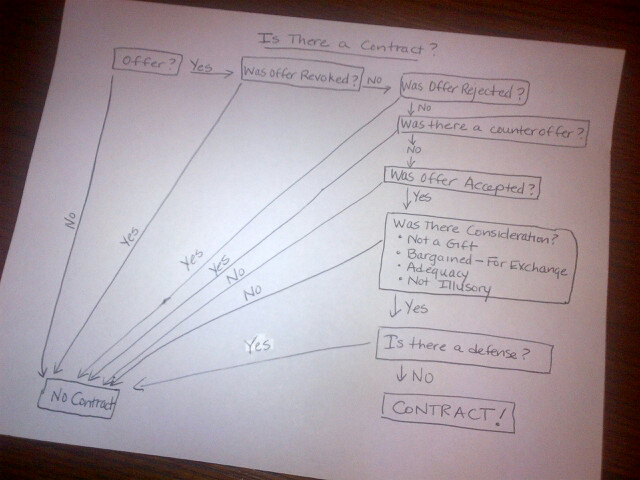
Here’s a simple example of how such a diagram or flow cart could be constructed. Let’s say you are reviewing Contracts, and you want to make sure that you remember the key steps for determining whether an enforceable contract has been created. Here’s what a simple version of that diagram might look like:contracts flow chart

Keep in mind, this would only be the starting point. As you continued to study, you might decide you want to incorporate more concepts into the flow chart, such as: (1) Mistake; (2) whether terms were definite; (3) whether promissory estoppel should apply; etc. You may make several versions of the flow chart before you have incorporated everything you want into it. The process of thinking through where all of the legal principles should fit will help you to remember them better, and in the end you will have a study aid that you can reference over the next several weeks as you study for the bar.

The key is to not get stuck studying your bar materials in a passive way—figure out a way to make it yours, and you will know it even better!

Leave a comment

Filed under Bar Exam, General, Study Tips

Flashcards and Bar Prep

By now, those of you who are studying for the July bar exam should be settling into a regular study routine. As you discovered during your time in law school, there are some legal concepts that you just have to memorize to be successful on an exam, whether it is the final exam in Torts or the bar exam. As a result, you may want to pull an old tool out of the study toolbox—flashcards. Flashcards can help you memorize important rules, tests, and definitions that you will need to recall during the bar exam. They can be especially helpful as you juggle learning and reviewing material from numerous bar subjects. Flashcards can also help you assess what you know versus what concepts you need to spend more time on, allowing you to make efficient use of limited time.

There are two possible approaches to flashcards: (1) the old school, index card type of flashcard that is either handwritten or typed (the “traditional” flashcard); or (2) digital flashcards that can be viewed on a computer, smartphone, iPad, or other digital reader. Each type has its benefits and drawbacks, as discussed below. You just have to decide which type will work best for you.

Traditional Flashcards:

Image courtesy of Stuart Miles/FreeDigitalPhotos.net

Image courtesy of Stuart Miles/FreeDigitalPhotos.net

First, let’s talk about the traditional flashcard. For those of you who do not like to study from a digital screen or aren’t as comfortable using technology, the traditional flashcard may be your default approach. One of the benefits of the traditional flashcard is that many students find that the process of writing out each card actually helps them to remember concepts better, even before they actually start studying from the cards. For people who like a visual reference of what has been accomplished and what is left to learn, stacks of flashcards satisfy that need. It is possible to carry around a small number of traditional flashcards regardless of where you go, and you don’t have to worry about low batteries, loss of internet connectivity, etc.

On the flip side, making handwritten flashcards can be a tedious process, especially when you are creating them for every bar subject. They are easily lost or ruined (such as when your elbow catches that cup of coffee and knocks it over). And if you are one of those people who tries to reduce the entire BarBri outline to a comprehensive series of flashcards, you may take so much time on one subject that nothing else gets done before it’s time to take the bar.

Digital Flashcards:

So what about digital flashcards? Digital flashcards also have their benefits and drawbacks. One of the benefits of digital flashcards is their portability. If you have a smartphone with a flashcard app, you literally can carry your flashcards with you everywhere you go. As I’ve talked about before, there are any number of basic flashcard apps available on the internet for free or at a low cost, such as Flashcard Machine and Quizlet. You may have already discovered a program that works really well for you. Depending on the program, there may be limitations though. It may be difficult to separate out cards that you want to concentrate on for a single study session, or the ability to temporarily combine particular subjects together in a random way (how it will be on the MBE) may be limited. Not all apps work on all devices either. Some only work on Apple devices, while others work with android platforms. Very few seem to work with Blackberries, if you happen to have one of those.

Another benefit—and drawback—to many digital flashcard programs is that they allow you to share your flashcards with others. On the plus side, this means that you and two of your best friends could divide and conquer the flashcard creation process . . . if you trust those people’s judgment calls about what is flashcard-worthy. On the negative side, most people end up knowing best the cards that they created themselves.

A New Type of Digital Flashcard for Law Students and Bar Takers: SeRiouS:

There is also a new digital flashcard program specifically for law students and bar takers called SeRiouS.

Here’s a video explaining how SeRiouS works:

From my exploration of the SeRiouS platform, there are two different ways that you can use it. First, you can utilize flashcards, created by law professors, on a variety of bar subjects. As it stands right now, there are over 600 different flashcards on mostly MBE topics, but it appears that more will be added over time. Second, you and your friends can create your own cards as well. The benefit to SeRiouS is that it draws upon scientific research regarding memory. As you go through each flashcard, you rate how confident you felt about your answer. Based upon your level of confidence, SeRiouS applies an algorithm to determine how often you see that flashcard as you study—a process called spaced repetition. The principle is that, as you start studying a topic, you need to review it frequently in order for it to be stored in your memory. As you continue to review that same topic over time, however, you need to see it less and less often to maintain it in your long-term memory. (I’m not an expert on the subject, but this is how I understand it.) One of the drawbacks to this program is that the website is a little hard to navigate at first until you figure out where everything is located, but it shows a lot of promise. A plus is your ability to chart your mastery of the cards (it gives you an update about your status) as well as gentle reminder emails to get back to reviewing your flashcard deck. At this point, SeRiouS is in the beta stage and available without cost to law students and bar takers at least through the July bar exam period.

**This blog post is not an endorsement of any product mentioned herein; I am just providing some suggestions of resources that are available for you to explore.

Leave a comment

Filed under Bar Exam, General, Study Tips, Technology

What Should You Do the Summer Before Starting Law School?

Congratulations on being admitted to law school! The next few years will be a time of challenges, opportunities, frustrations, and successes. Law school will be hard work, but, if you approach it the right way, it will also be one of the most rewarding experiences of your life. So, what should you do this summer before you enter law school? Here are a few suggestions:

Learn more about what to expect during your first year in law school. For many law students, the first semester of law school can be a real shock. Law school is like nothing you have ever experienced. Talk to current law students and lawyers about what to expect during the first week, month, and semester in law school. Ask them what they wished they had known as a new 1L. There are also a number of good books out there for new law students. These books can provide more information about what it is like to be a law student, what skills you need to develop (and even some suggestions about how to develop those skills), and what the language of law school means. You don’t need to read every book out there though—one or two is probably sufficient to get you started.

Some books that you may find helpful (in no particular order):

Starting Off Right in Law School (2nd ed.), by Carolyn J. Nygren. This book is an interesting read, as it uses a fictional case to introduce students to the vocabulary and skills of law school and legal practice.

Getting to Maybe: How to Excel on Law School Exams, by Richard Michael Fischl and Jeremy Paul. This book discusses the differences between undergrad and law school approaches to studying, explains how legal reasoning works and how to apply legal reasoning to class and exam preparation. Much of the focus is on how to perform well on law school exams, and it may be most helpful to read once you are part way through your first semester.

1L of a Ride: A Well-Traveled Professor’s Roadmap to Success in the First Year of Law School (3rd ed.), by Andrew J. McClurg. This book provides a straightforward explanation of what to expect during the first year of law school, including suggestions and comments from former law students.

Expert Learning for Law Students (2nd ed.), by Michael Hunter Schwartz. This book provides a lot of useful advice about how to tackle the various skills you need to develop and tasks that you must accomplish as a law student. It also helps you to understand more about how you learn, and how you can approach law school based upon your learning preferences.

Reading Like a Lawyer: Time-Saving Strategies for Reading Law Like an Expert (2nd ed.), by Ruth Ann McKinney. This book focuses specifically on how you can develop the reading skills you need to effectively and efficiently read for law school.

Learning Outside the Box: A Handbook for Law Students Who Learn Differently, by Leah M. Christensen. This book is a great resource for students who learn differently from the average student, including those who have diagnosed or undiagnosed learning disabilities that affect the way they learn.

This is not an exclusive list—there are certainly other books out there that may be helpful in introducing you to what to expect in your first year of law school. Ask law students you know about any books or other resources they have found particularly helpful.

Make your health a priority. There are a lot of studies out there that demonstrate links between taking good care of yourself—eating healthy foods, getting exercise, and getting enough sleep—and cognitive skills and stress management. Make lifestyle changes that improve your health even before law school begins, and continue those new habits into the school year. You will be better off for making your health a priority in the long run.

Finally, take some time to relax and recharge your batteries before law school begins this fall. Some people try to do too much during the summer before law school—reading every book about being a successful law student, trying to get a head start on first-year law school course materials, etc. Your first semester of law school will be an intense, demanding experience, and it is important to go into it feeling rested and ready to tackle the challenge. Read for fun. Go on long walks. Spend time with friends and family. Do the things that make you happy and renew your spirit!

Stay tuned to this blog over the next couple of months–I will be adding additional posts on this topic!

Leave a comment

Filed under General, Law School Exams, Pre-Law, Study Tips

Making the Most of Summer Law School Classes

Image courtesy of naypong/FreeDigitalPhotos.net

Image courtesy of naypong/FreeDigitalPhotos.net

Many law students choose to take classes during the summer because (a) they want to graduate in less time, or (b) to reduce the number of classes they have to take in future semesters. Students often believe that summer classes will be “easier” because they are only taking one or two classes instead of five. Although there is definitely a benefit to taking fewer classes at one time, the drawback is that summer classes generally last half the time. Instead of lasting 14 or 15 weeks, the entire course is usually crammed into 7 weeks.

How can you make sure that you obtain the greatest benefit from taking summer classes and set yourself up for academic success? Here are four tips for making the most of your summer law school classes:

1. Create a study schedule, and stick to it. It can be tempting to take a relaxed approach to your studies in the summer, as there are so many distractions: summer movie series, outdoor activities, longer days . . . you get the picture. You should definitely make sure you take some breaks and enjoy your summer, but you still have to take a disciplined approach to your studies. The best way to do this is to create a study schedule for the summer semester. You don’t want to get behind in a class that only lasts 7 weeks.

2. Start outlining early; don’t wait until the last minute. Students often wait until several weeks into a semester to start outlining. If you take this approach in the summer, the outline will never be finished. Outline each topic as you finish it in class, and you will be better prepared for the final exam. Even though it’s summer, you still have to do the same things you need to do during the rest of the school year to be successful.

3. Don’t miss class unless you absolutely have to. Missing one class during the summer is often the equivalent of missing a week during the rest of the year. When a class has a condensed schedule, it can be difficult to get caught up if you miss even one class. Save class absences for true emergencies, and have a plan for getting quickly caught up if you have to miss class.

4. Learn from the past; don’t repeat it. Make sure that you review your exams from Spring Semester. If you did not do as well as you hoped in a class, set up an appointment to go over your exam. I’ve also discussed how to get the most out of past grades here and here. Use those past final exams as a basis for how to approach future exams.

Taking summer classes can contribute to your overall success as a law student if you approach them in the right way. Make the most of your summer studies!

Leave a comment

Filed under General, Grades, Law School Exams, Study Tips

Accountability Creates Motivation: Studying for the Bar Exam, Part 3

It’s now only two months before the July Bar Exam, and everyone should be busy studying at this point. At times, it can be hard to find the motivation to study, especially when the exam date still feels like it’s far away. Your commercial bar prep program may seem a little monotonous, as you seem to do the same thing every day: watch a lecture (whether in person or online), study the outlines and supplemental materials, complete the practice questions, repeat. It can be tempting to watch TV, play computer games, or do something else when you should really be studying. Keeping yourself motivated at this time is key, and one way to motivate yourself is to establish some type of accountability system.

What do I mean by accountability? Sometimes it is easier to not focus on what we need to be doing when we feel that no one will know about our lack of progress on our studies. If your bar review course gives you the option of attending lectures in person or watching them online, attending them in person may help you to be more accountable for your studies—the people around you will notice if you are missing. It can also help to set up some type of accountability system with a friend who’s also studying for the bar exam. It may be that you just touch base with each other every couple of days to make sure you are each on track with your study goals, or you may actually schedule study sessions where you quiz each other on material that you have just finished reviewing. Another way to create accountability would be to reach out to someone in charge of Academic Success or Bar Skills programs at your law school. Explain what your study goals are and that you want to create some type of accountability system to keep you on track.

When you know that someone cares about your achieving your study goals and will know if you don’t achieve them, you will be more motivated to stay on focused on your studies. Accountability creates motivation!

Leave a comment

Filed under Bar Exam, General, Study Tips

Countdown to the Bar Exam, Step 2: Creating the Right Study Environment

Photo courtesy of Apolonia/freedigitalphotos.net

Photo courtesy of Apolonia/freedigitalphotos.net

One important element of studying for the bar exam is creating the right study environment. You can have the best intentions, but the wrong environment can derail your entire study plan. One key to effective studying is a location that allows you to study efficiently and without distractions.

Here are some things to think about as you decide where to study for the bar:

What were the things that distracted you from studying when you were in law school? If you are constantly tempted to turn on the TV, then studying in your living room may not be for you. If studying in the law school library meant that you visited with friends rather than getting work done, then the same might hold true as you study for the bar. Some people prefer the background noise of a coffee shop, while others find themselves listening in to every conversation at the tables beside them. Be realistic in your assessment of what distracts you, and choose a study environment that avoids those distractions.

What do you like to do when you take breaks from studying? If you want to be able to take a short walk, then setting up your study station at the local coffee shop may not make sense—you won’t want to have to pack up your stuff every time you take a break. On the other hand, if your idea of a great break is checking your email and spending 20 minutes playing computer games, then a more public location may not be an issue. Just make sure that your study location is conducive to taking study breaks.

What space do you need to study? Some people prefer to study at a desk or table, where they can spread out their materials and have plenty of space to work. Others prefer to sit on a comfortable couch, overstuffed chair, or even the floor. Think about what type of space makes you feel most comfortable when you are studying—you’re going to spend a lot of time there.

Do you want to be able to eat or drink while studying? This is an important consideration, as many people like to have snacks and drinks available as they study. If you want endless amounts of coffee or periodic snacks of pretzels, fruit, etc., a library with a strict food and drink policy may not be the place for you. Likewise, if you are on a tight budget this summer, an expensive coffee shop may not work as well. Choose a study location that fits with your snacking habits.

Finally, do you like the routine of studying in the same space all the time, or will you need to change things up periodically? For some people, maintaining the same routine every day—studying at the same place at the same time—works best. For others, a little variety in the order and location of the routine helps them to stay focused. Depending on your own preferences, you may find that you want to change up your study location sometimes. Periodically reassess your study environment and make sure it still works best for you.

The perfect study environment is a very personal thing—experiment and find out what works best for you!

Leave a comment

Filed under Bar Exam, General, Study Tips

Why Law Review?: Five Ways that Serving on a Law Review Contributes to Academic Success

It’s that time of year in law school when 1Ls (now rising 2Ls) are completing law review writing competitions, hoping for the invitation to join the journal of their choice. Sure, working on a law review staff is a lot of work, but there are also many benefits. For those of you who are on the fence about whether to join a law review, I thought I would put together a list of five ways that serving on a law review can contribute to your overall academic success in law school. Here it is:

1. You will gain an in-depth understanding of the BlueBook. No longer will you hesitate when trying to remember how to abbreviate case names, when there is a space after a period in a citation versus when there is not, or when it is proper to use “see” as a signal. Your newfound confidence in your Bluebooking expertise will serve you throughout the remainder of your law school days, as well as in law practice afterwards.

2. Working with good (and bad) writing helps to make you a better writer. The more writing that you read and critique, the better your own writing skills get. As you read and edit other people’s writing, you will become more conscious of your own writing. Of course, you will learn more about grammar through this process, but you will also learn about what it takes to write effectively—in other words, to communicate precisely, clearly, and concisely.

3. You will learn how to manage your time more efficiently. It is no secret that working on the staff of a law review requires significant time. And time is already in short supply in law school, as you discovered during your first year as a student. Juggling your journal work with your studies will inspire you to develop even better time management skills.

4. You will find new mentors. One of the greatest benefits to working on a law review is that you will develop new relationships with upper-level law students. During your 1L year, you take all of your classes with the same people, who are all 1Ls as well. Once you are a 2L, your classmates will be more diverse. Working with upper-level students on law review is a great way to make connections with some of those new classmates. They can be great resources for you, as they have more experience.

5. You will learn how to collaborate better with others. The law school environment tends to be pretty competitive, but law review is one place where you quickly learn the benefits of collaboration. The people skills you learn by working on a journal will help you not only in getting issues to press but also in classes where teamwork and cooperation is often essential, such as Negotiations, Mediation, and Trial Practice.

Only you know if working on a law review is the right thing for you—but, as you can see, there are a lot of hidden benefits to journal service!

Leave a comment

Filed under General, Legal Writing and Oral Arguments, Study Tips